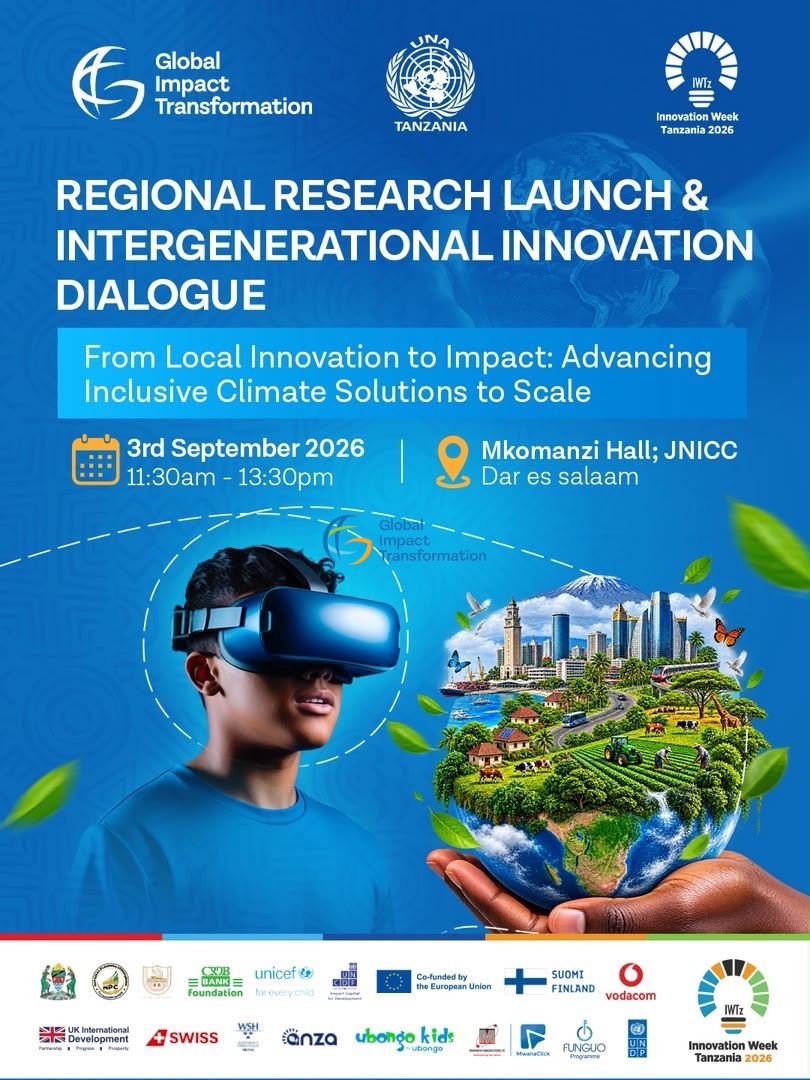
Global Impact Transformation (GIT), together with research partners representing Eastern, Central and Southern Africa, will officially launch a major regional research study on community-led climate adaptation and local innovation on 3 September 2026 at Mkomanzi Hall, Julius Nyerere International Convention Centre (JNICC), Dar es Salaam, during Innovation Week Tanzania 2026. Hosted during Innovation Week Tanzania under the UNDP FUNGUO Innovation Programme, the Regional Research Launch and Intergenerational Innovation Dialogue will be held under the theme: “From Local Innovation to Impact: Advancing Inclusive Climate Solutions to Scale.” The convening comes at a critical moment as communities across Africa face increasingly complex climate risks while continuing to generate locally grounded knowledge, innovations and adaptation solutions. The launch will provide a strategic platform to bring this evidence into dialogue with policy, programming, technology, partnerships and investment, with a focus on what is needed to strengthen promising locally led solutions and take them to greater sustainability and scale.
Advancing community-led climate solutions from evidence to action and scale
By Communication team
The regional research is a collaborative initiative led by Global Impact Transformation (GIT) together with partners across Africa, including United Nations Association Tanzania (UNA Tanzania), ISOKO Partners for Peace and Gender Equality, CIDEP Burundi, GADC Mozambique, Ethiopian Youth for Peace and Development, South West State Organization (SWSO–Somalia), and Kenya Youth for SDGs. Together, the partnership brings diverse country experiences, community perspectives and institutional expertise into a shared regional effort to strengthen evidence and learning on locally led climate action.
The research spans Tanzania, Kenya, Ethiopia, Somalia, Burundi, the Democratic Republic of the Congo (DRC), and Mozambique, bringing together perspectives from Eastern, Central and Southern Africa. This geographic representation reflects diverse yet interconnected climate realities across fragile and climate-vulnerable contexts, creating a strong regional evidence base for understanding both the challenges communities face and the locally developed solutions emerging in response.
The research examines community-led climate adaptation and local innovations in fragile and climate-vulnerable contexts. It documents community-led adaptation practices, indigenous and local knowledge, livelihood diversification strategies and locally developed climate solutions, while examining the factors that influence their effectiveness, sustainability and potential for scale.
By connecting evidence across different African contexts, the research seeks to identify common lessons and enabling conditions that can inform policy, programme design and implementation, partnerships and investment in locally led climate action. It also creates an opportunity for solutions emerging within individual communities to contribute to wider national and regional learning and action.
Communities at the Centre of Climate Innovation
Across climate-vulnerable settings, communities are not only experiencing the impacts of climate change, they are also generating knowledge, adapting livelihoods and developing locally grounded solutions in response.
Drawing on indigenous and local knowledge, lived experience, new technologies and innovative approaches, communities continue to demonstrate resilience and ingenuity. Yet many promising solutions remain small-scale or disconnected from the technical support, financing, markets, institutions and partnerships required to sustain, replicate and expand them.
The research therefore places communities at the centre not simply as beneficiaries of climate interventions, but as knowledge holders, innovators and partners whose experiences can contribute to more responsive climate policies, programmes and investments.
The launch will provide an opportunity to examine what is already working, what can be learned across different contexts, why promising locally led solutions struggle to progress, and what needs to change within the wider enabling environment to support their sustainability and scale.
A central feature of the launch will be the Intergenerational Innovation Dialogue, bringing together different generations, sectors and professional perspectives to engage with the research findings and explore practical pathways from evidence to action.The dialogue will connect community experience, youth leadership, research, policy and programming, innovation and technology, entrepreneurship, climate mobility, development cooperation and partnerships.
The dialogue will also recognise that climate impacts are not experienced equally. Perspectives on women, young people, persons with disabilities (PWDs), displaced and climate-affected populations, alongside issues of gender, protection, social cohesion and community resilience, will help ensure that discussions on innovation and scale remain grounded in inclusion and local realities.
The convening is expected to bring together representatives from government, diplomatic missions, United Nations agencies, development partners, academia and research institutions, civil society, environmental and climate institutions, the private sector, financial institutions and investors, technology and innovation actors, youth and women's networks, organisations of persons with disabilities, community-led organisations and other professionals.
This diversity is deliberate, advancing locally led climate solutions requires collaboration across sectors and institutions. Evidence must inform policy and programming; innovation must connect with technology and markets; innovators need pathways to finance and investment; partnerships must unlock expertise and resources; and communities must remain active participants in decisions affecting their resilience and future.
By bringing these actors into one space, the convening aims to strengthen connections between those generating knowledge and solutions at community level and those shaping policies, programmes, partnerships and investment decisions.
Participation is by invitation only. Organisations, institutions and other stakeholders interested in participating may contact Global Impact Transformation (GIT) at info@globalimpacttransformation.org or via +255 755 247 428 / +255 717 026 509 for further information.
From local innovation to regional impact, GIT and its partners are creating a platform to move community-generated evidence and locally led solutions beyond documentation towards stronger policy, responsive programming, strategic partnerships, investment and action at scale.