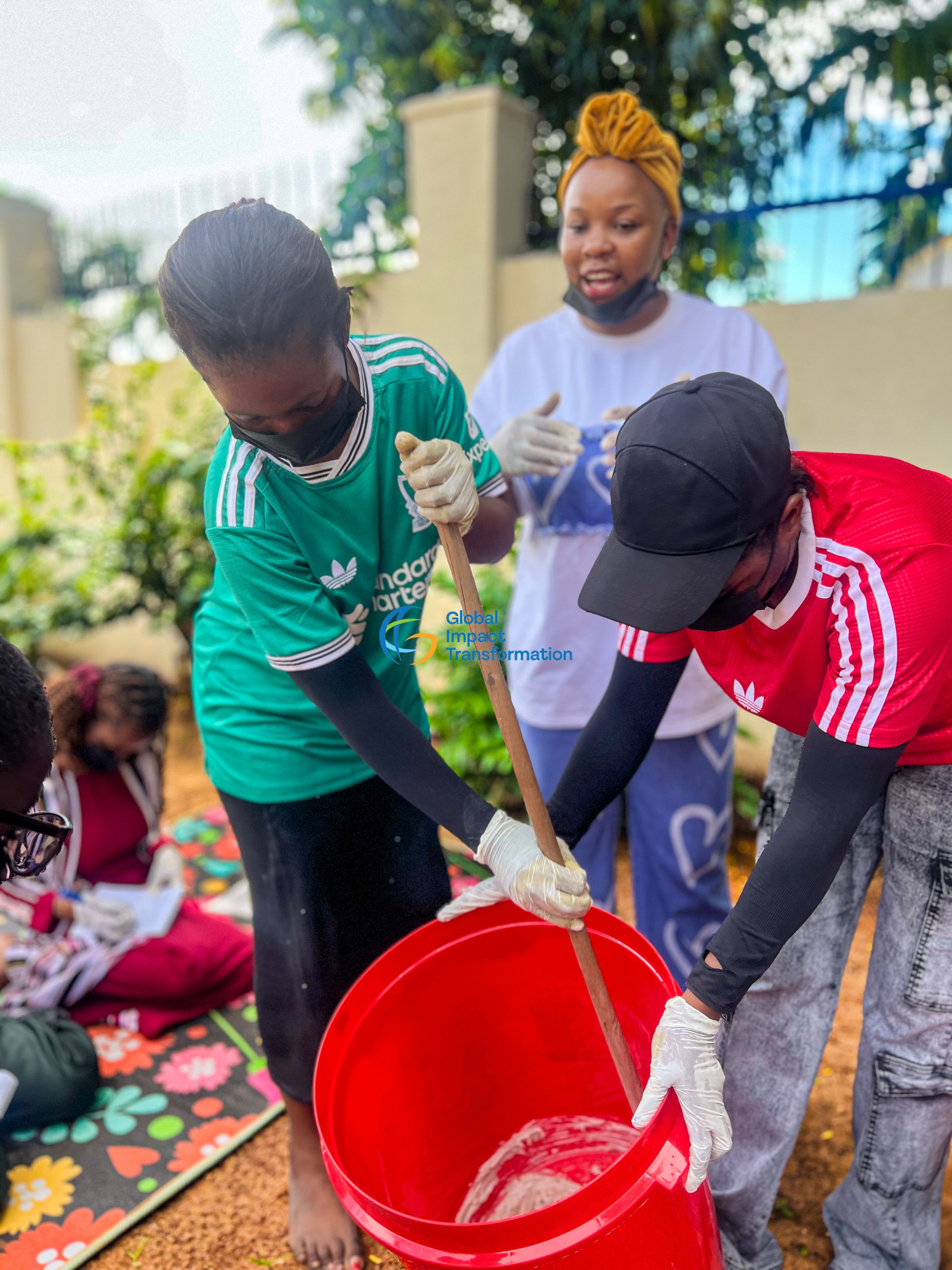
Youth unemployment remains one of the most urgent development challenges globally, across Africa, millions of young people enter the labour market each year facing limited access to jobs, practical skills, mentorship, and economic opportunity. In Tanzania, the country’s youthful population presents enormous promise, but also a clear need for stronger investment in employability, entrepreneurship, innovation, and pathways to self-reliance. Responding to this opportunity, Global Impact Transformation (GIT), in strategic partnership with Her Initiative, continues to champion practical and innovative solutions that prepare young people especially girls and young women, while inclusively engaging all youth to thrive in a changing economy. Through the MSHIKO Clubs 2026 Programme, GIT and Her Initiative conducted a hands-on green entrepreneurship session at Saranga Secondary School in Dar es Salaam, introducing students to the production of eco-friendly liquid soap using locally available materials and practical small enterprise pathways.
Advancing Innovation through green skills
By Communication team
To respond to rising youth unemployment and the growing demand for future-ready skills, the session was designed as a Training of Trainers (ToT) model that bridges classroom learning with real-world opportunity by equipping students with practical competencies rooted in sustainability, creativity, and enterprise development. The ToT session directly engaged 11 student trainees, including 8 girls and 3 boys, who were selected as peer champions to cascade knowledge within the school community. Under the model, each trainee is expected to transfer skills and entrepreneurship knowledge to at least 10 fellow students. Through this multiplier approach, the initiative is projected to reach at least 110 students by the end of Quarter Two (June 2026), significantly expanding impact through peer-led learning, youth leadership, and shared innovation.
Facilitated through the Global Impact Transformation (GIT) Champions Network, led by Anna Mwaisaka, the training demonstrated how locally available materials can be transformed into useful market-ready products. Participants were encouraged to view innovation, green enterprise, and entrepreneurship as realistic pathways to income generation, self-reliance, and long-term economic resilience.
Many young people complete school with limited exposure to practical business skills, sustainability solutions, or entrepreneurship pathways. For girls and young women, these barriers can be even greater due to unequal access to networks, resources, and opportunity spaces. School-based initiatives such as MSHIKO Clubs help close this gap by creating peer-led learning spaces where students gain practical skills, leadership confidence, environmental awareness, and self-employment possibilities. The ToT training combined live demonstrations, interactive participation, peer learning, and guided discussion. Students learned step-by-step processes for producing eco-friendly liquid soap and explored how simple green products can become sustainable micro-business opportunities.
Discussions also focused on Green entrepreneurship as a pathway to self-employment, Turning local materials into marketable products, Innovation through practical problem solving, Leadership through peer learning and building a future-ready and environmentally conscious mindset
The session generated immediate results by strengthening practical skills, increasing entrepreneurship awareness, and preparing participants to cascade learning to other students.
Participants gained, practical green production skills, increased understanding of small business opportunities, greater confidence to train peers and apply knowledge productively, stronger appreciation of skills-based learning, motivation to explore income-generating ideas and ncreased interest in innovation and self-employment pathways
The strong participation of girls also reinforced the importance of investing in young women’s leadership and economic empowerment through school-based platforms. Global Impact Transformation believes that addressing youth unemployment requires more than job creation alone. It requires investment in innovation, entrepreneurship, practical skills, mentorship, and green enterprise ecosystems that enable young people to create opportunities for themselves and others.Through partnerships such as Her Initiative, GIT continues to expand access to empowerment opportunities that strengthen confidence, agency, leadership, and economic resilience among young people.
Following the Saranga Secondary School engagement, GIT and Her Initiative aim to expand MSHIKO Clubs 2026 to additional schools and youth spaces while scaling the Training of Trainers model to multiply impact. Future priorities include mentorship support, student-led enterprises, innovation exposure, peer-led learning, and stronger collaboration with education stakeholders.
A Shared Call to Action
Youth unemployment is not only an economic issue, it is a development, equity, and future-readiness issue. Investing in young people through innovation, leadership, and sustainable enterprise is one of the smartest and most urgent investments any society can make. Global Impact Transformation welcomes collaboration with stakeholders committed to youth employability, entrepreneurship, girls’ empowerment, green innovation, and inclusive economic opportunity across Tanzania.
To explore collaboration opportunities, please contact: info@globalimpacttransformation.org

